Email: [email protected]

Restoration vs. Renovation vs. Remodeling: Which Pathway Does Your Austin Home Need?
If you are planning a project for your Austin home, you’ve likely thrown around the words restoration, renovation, and remodeling interchangeably. It’s a common habit. In casual conversation, "we’re remodeling the kitchen" can mean anything from buying a new refrigerator to tearing down the structural walls dividing the first floor.
However, in the residential construction world, these three terms represent entirely different pathways. They involve vastly different budgets, timelines, architectural requirements, and interactions with the City of Austin’s permitting department.
Because R1 Construction specializes in all three tracks, we know that choosing the wrong pathway can result in mismatched expectations, blown budgets, or legal headaches. Let’s break down exactly what each term means, how they compare, and how to determine the exact path your property needs to take.
1. Restoration: Reversing Damage and Preserving History
At its core, restoration is about turning back the clock. It focuses on returning a home, or a specific room, to its exact previous condition. In our industry, restoration projects typically fall into one of two distinct categories:
Emergency Disaster Recovery
When an Austin home suffers a sudden trauma, such as a burst pipe flooding a living room, a kitchen grease fire, or severe mold growth after a flash flood, the immediate goal is mitigation and restoration. The objective is to extract the hazard, dry or clean the structure, and rebuild the space so it looks exactly as it did the day before the incident (pre-loss condition).
Historical Preservation
For older homes in historic Austin neighborhoods like Hyde Park, Clarksville, or Pemberton Heights, restoration means meticulously repairing the original architectural details. Rather than modernizing, a historic restoration utilizes period-accurate materials to preserve the home’s original character while updating its safety infrastructure behind the scenes.
Key Indicators You Need Restoration: Active water intrusion, smoke/soot damage, hidden mold, or a historic property requiring strict architectural preservation.
The Blueprint: Heavy coordination with insurance adjusters, structural safety checks, and forensic material matching.
2. Renovation: The High-Impact Cosmetic "Facelift"
To renovate means to renew, refresh, or update. A renovation path is entirely focused on aesthetics, style, and comfort. The defining characteristic of a renovation is that the existing structural layout of the home remains completely unchanged.
During a renovation, the walls stay exactly where they are, the plumbing fixtures remain on their original drain lines, and the room's footprint is untouched. Instead, the budget is funneled directly into updating the visible finishes and surfaces that give a home its character.
Common Renovation Projects Include:
Swapping out outdated laminate or tile countertops for premium engineered quartz or granite.
Cabinet refacing or professional cabinet painting to modernize a kitchen's appearance.
Replacing worn carpet or outdated tile with engineered hardwood or Luxury Vinyl Plank (LVP).
Upgrading the "jewelry" of the home: updating plumbing faucets, cabinet hardware, and statement lighting fixtures.
Transitioning an older home into a modern, cozy color palette using color-drenching paint techniques.
Key Indicators You Need Renovation: Your current layout works perfectly, but the style feels tired, dated, or worn out.
The Blueprint: Maximum visual return on investment (ROI), rapid construction timelines, minimal structural demolition dust, and generally no requirement for complex municipal building permits.
3. Remodeling: Custom Structural Transformation
To remodel means to alter the structure, function, and flow of a space. This is the path of precision engineering and custom transformation. If a renovation changes the appearance of a room, a remodel fundamentally changes its DNA.
Remodeling involves changing the physical footprint of your home. It requires tearing down walls, reallocating square footage from one room to another, expanding footprints, or converting underutilized spaces into entirely new functional zones. Because you are altering the structural integrity of the building and moving its mechanical lifelines, remodeling demands architectural drafting and certified structural engineering.
Common Remodeling Projects Include:
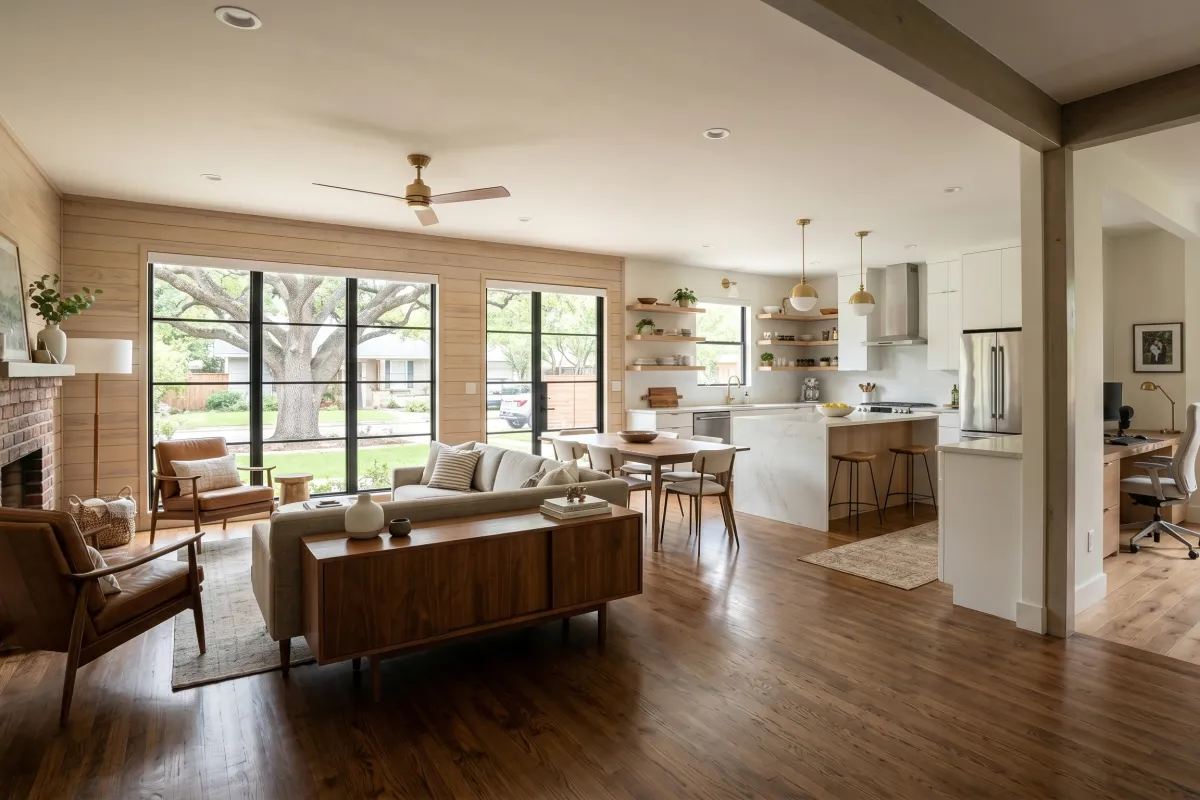
Removing load-bearing walls to connect a segmented kitchen and living room into a modern, open-concept great room.
Expanding a cramped primary bathroom by absorbing space from an adjacent walk-in closet or spare bedroom to build a custom spa-like retreat.
Repurposing an empty, underutilized formal dining room into a private, acoustic-insulated home office or a multi-generational living suite.
Digging up concrete slabs to completely relocate major plumbing lines, gas lines, and electrical zones for a custom kitchen refiguration.
Key Indicators You Need Remodeling: Your home feels cramped, traffic bottlenecks are frustrating, you lack functional space, or the flow of the layout actively works against your daily routine.
The Blueprint: Architectural drafting, structural beam calculations, navigating the rigorous City of Austin permitting process, and a comprehensive 3-to-12+ month construction timeline.
The Cross-Over Reality:
These pathways often bleed into one another. For example, if an Austin home experiences severe water damage in the kitchen, the homeowner must initiate a restoration project to dry out the framing. However, rather than putting back the exact same 1980s cabinets, they may choose to pay out of pocket to renovate the finishes, or go a step further and remodel the layout by knocking down a wall while the drywall is already open.
Which Pathway Does Your Austin Home Need?
Choosing your path comes down to answering one foundational question: Is it the style that frustrates you, or is it the footprint?
If your home’s layout handles your daily routine beautifully but looks like a time capsule, a renovation will give you the breathtaking transformation you want with minimal disruption. If you are constantly tripping over family members, lacking light, or wishing your kitchen connected to your living room, a structural remodel is the only way to unlock your home's true potential. And if disaster strikes, rapid restoration is your first line of defense.
Partner with Austin’s Full-Spectrum Specialists
At R1 Construction, we don't believe in one-size-fits-all templates. Whether you need to recover from an unexpected emergency, execute a seamless cosmetic facelift, or completely re-engineer your home’s layout with an open-concept remodel, our team delivers with precision, transparency, and purpose.
Let’s build the right solution for your home. Contact our Austin team today to schedule your complimentary structural or design consultation.
How Can We Help?
Whether you need a team on-site in 45 minutes for an emergency or want to schedule a walkthrough for a future project, we are here to help.
Call Emergency Response Now 24/7
Request a Consultation
Insurance Carriers We've Worked With































Frequently Asked Questions
Do I need a building permit from the City of Austin for a home renovation?
Generally, no. If you are pursuing a purely cosmetic renovation, such as replacing flooring, painting cabinets, or swapping out countertops, the City of Austin rarely requires a building permit. However, the moment your project crosses into a remodel (tearing down walls, moving plumbing lines, or altering electrical zones) or requires structural restoration repairs, full municipal building and trade permits become strictly mandatory.
Can I combine an emergency restoration with a remodel or renovation?
Absolutely, and it is often the smartest time to do so. In the industry, this is known as the "cross-over reality." If a burst pipe or flash flood forces you into an insurance-backed restoration project, your home will already be down to the studs. While the structure is open and the construction dust is already flying, you can choose to pay out-of-pocket to upgrade your finishes (renovation) or knock down a frustrating wall (remodel) rather than just putting the old layout back.
How do I know if my kitchen needs a renovation or a structural remodel?
To figure out your path, ask yourself one foundational question: Is it the style that frustrates you, or is it the footprint?
Choose Renovation if: Your kitchen's workflow handles your daily routine beautifully, but the aesthetics look like a total time capsule.
Choose Remodeling if: You are constantly tripping over family members, traffic bottlenecks drive you crazy, or you feel completely isolated from the living room while cooking.
What makes a historic "restoration" different from a standard home update?
In older, historic Austin neighborhoods like Hyde Park, Clarksville, or Pemberton Heights, a restoration is about preservation rather than modernization.
Instead of tearing out old features to match current design trends, a historic restoration focuses on turning back the clock. It utilizes period-accurate materials to meticulously repair original architectural details, while safely updating the home's hidden infrastructure (like plumbing and wiring) behind the scenes.
Which of the three construction pathways takes the longest to complete?
Hands down, remodeling requires the longest timeline. Because a remodel fundamentally alters the DNA of your home, it demands a comprehensive 3-to-12+ month timeline to accommodate: Architectural drafting and structural beam calculations, Navigating the rigorous City of Austin permitting process, Complex structural demolition and mechanical relocation. Cosmetic renovations are significantly faster, while restoration timelines vary wildly depending on the severity of the property damage.
Will my homeowner’s insurance cover a renovation or a remodel?
Nice try, but unfortunately, no. Insurance companies only cover restoration work tied to sudden, unexpected disasters (like a kitchen grease fire, mold mitigation, or a plumbing failure) to return the property to its "pre-loss condition." Elective changes to improve your lifestyle (remodeling) or aesthetic updates to boost your home's ROI (renovation) are entirely funded out-of-pocket.

Bringing Your Home Back to Life.
Email: [email protected]
Phone: (512) 812-9990
Serving: Austin, TX & Surrounding Central Texas Communities


Business hours
Monday: 9 AM to 5 PM
Tuesday: 9 AM to 5 PM
Wednesday: 9 AM to 5 PM
Thursday: 9 AM to 5 PM
friday: 9 AM to 5 PM
Copyright 2026. R1 Construction. All rights reserved.